
Private Caregiver vs. Home Care Agency: What Louisiana Families Should Know
Sep 3, 2026 | Moore Care

When an aging parent or loved one begins needing help at home, many families face the same question:
Should we hire a caregiver privately, or should we use a licensed home care agency?
At first glance, hiring someone directly can seem like the simpler and more affordable option. Maybe a friend recommends someone they trust. Maybe a caregiver is willing to work for a lower hourly rate if the family pays them directly.
But the hourly rate isn’t the only difference between private hiring and working with a licensed in-home care agency.
Before making that decision, Louisiana families should understand the responsibilities — and potential risks — that can come with becoming a caregiver’s employer.
When You Hire a Caregiver Directly, You May Become the Employer
One of the biggest misconceptions surrounding private caregivers is that a casual arrangement doesn’t necessarily create an employer-employee relationship.
In reality, how the working relationship functions matters.
If your family determines when the caregiver works, directs what they do, and pays them regularly, the arrangement may carry employment responsibilities — even if you never intended to become an employer.
That can potentially include responsibilities involving payroll taxes, Social Security and Medicare contributions, recordkeeping, and other employment requirements.
For a family already managing medications, appointments, finances, household responsibilities, and the emotional challenges of caring for an aging parent, becoming an employer can add another layer of complexity.
What Happens If a Private Caregiver Gets Hurt in Your Home?
Caregiving can be physically demanding.
Caregivers may help with transfers, bathing, mobility, toileting, dressing, and other activities of daily living. Those tasks can create opportunities for injuries such as back strains, falls, or other accidents.
Louisiana law exempts certain work performed by employees of private residential householders from workers’ compensation coverage. However, the statute also provides that, where applicable, an employee may seek recovery through a personal injury claim or applicable insurance coverage.
Without workers’ compensation coverage, an injured worker may instead pursue other legal remedies depending on the circumstances.
That’s an important distinction for families to understand.
Don’t Assume Your Homeowner’s Insurance Covers Everything
Families sometimes assume their homeowner’s insurance would automatically protect them if a privately hired caregiver were injured in their home.
Coverage isn’t always that simple.
Policies, exclusions, household employee provisions, and individual circumstances vary considerably. Families considering private employment should speak with their insurance provider about exactly what their policy does and does not cover.
Finding out after an accident is not the time to discover a gap in coverage.
The Hourly Rate Doesn’t Tell the Whole Story
The appeal of hiring privately is understandable.
A private caregiver may charge less per hour than a licensed home care agency. Over weeks and months, those savings can appear significant.
But when comparing costs, families should look beyond the hourly rate.
Consider what happens when the caregiver:
- Calls in sick
- Takes a vacation
- Leaves unexpectedly
- Gets injured
- Isn’t the right personality fit for your loved one
- Needs additional training or supervision
- Can no longer accommodate your family’s schedule
Families hiring privately may suddenly find themselves responsible for finding backup care, managing employment issues, or going through the hiring process all over again.
With an established home care agency, much of that responsibility shifts away from the family.
What Does a Licensed Home Care Agency Handle?
Working with a licensed agency isn’t simply about finding someone to sit with Mom or Dad.
The agency infrastructure behind that caregiver matters.
At Moore Care, our caregivers are employees of our company. We handle the employment responsibilities, including payroll and applicable taxes, and our caregivers are covered under our workers’ compensation policy.
Our team also handles caregiver screening, background checks, training, scheduling, supervision, and care coordination.
And when someone’s regular caregiver can’t make a scheduled shift, families aren’t left completely on their own trying to find someone at the last minute.
That support is part of what families are paying for when they choose professional in-home care.
Private Caregiver vs. Home Care Agency
With a privately hired caregiver, the family may be responsible for:
- Employment and payroll responsibilities
- Determining appropriate insurance coverage
- Screening and background checks
- Verifying qualifications and experience
- Scheduling
- Finding replacement caregivers
- Managing performance concerns
- Handling potential employment or injury-related issues
With a licensed home care agency like Moore Care, the agency handles those responsibilities while the family focuses on their loved one.
That distinction becomes especially important as care needs increase.
“But We Know and Trust the Caregiver”
Trust absolutely matters in caregiving.
But trusting someone personally doesn’t eliminate the practical realities of employing them.
A wonderful caregiver can still get hurt.
A dependable caregiver can still become sick.
A longtime family friend can still eventually need another job.
The decision to use an agency isn’t necessarily about whether a private caregiver is a good person or a good caregiver. It’s about the structure surrounding the care.
Families deserve both compassionate care and a system designed to support it.
Questions to Ask Before Hiring a Caregiver Privately
If your family is considering hiring someone directly, take time to ask:
- Who will legally employ this caregiver?
- Who will handle payroll and employment taxes?
- What happens if the caregiver is injured while working in the home?
- Does our homeowner’s insurance cover household employees?
- Has a comprehensive background check been completed?
- How have the caregiver’s qualifications and experience been verified?
- Who supervises the caregiver?
- What happens if the caregiver calls out or goes on vacation?
- Who finds replacement care if the caregiver quits?
- What happens as our loved one’s care needs increase?
Understanding those answers can help your family make a much more informed decision.
Peace of Mind Is Part of the Care
Choosing care for someone you love is about more than finding the lowest hourly rate.
It’s about knowing someone will show up.
It’s knowing the caregiver has been properly screened.
It’s knowing there’s a team to call when something changes.
And it’s knowing your family doesn’t have to become a home care company just because Mom or Dad needs help.
At Moore Care, we provide professional in-home care throughout the Greater Baton Rouge area with caregivers who are screened, supported, insured, and covered under our workers’ compensation policy.
Your family should be able to focus on your loved one. Let us handle the rest.
Looking for In-Home Care in Baton Rouge?
If you’re comparing private caregivers and professional home care for yourself or someone you love, we’re happy to help you understand your options.
Contact Moore Care today to learn more about personalized in-home care in Baton Rouge and surrounding communities.
This article is provided for general informational purposes and is not legal, tax, or insurance advice. Employment classifications, insurance coverage, and individual circumstances vary. Families with specific questions should consult an appropriate Louisiana attorney, tax professional, or insurance provider.
Category: At Home Care, Elder Care, Home Care
Tags: In-home care
Recent Posts

Caring for Elderly Parents: How Siblings Can Share the Responsibility | Baton Rouge Elder Care
Caring for elderly parents is a responsibility many families eventually face. While helping Mom or Dad can be incredibly meaningful, elder care can also become physically, emotionally, and logistically demanding, especially when one sibling begins carrying most of the responsibility. Between work, children, appointments, household responsibilities, and everyday life, it isn’t always realistic for one…

How Do I Know If My Parent Needs In-Home Care? 7 Signs to Watch For
If you’ve been asking yourself this question, you’re not alone — and the fact that you’re paying close attention is already a sign of how much you love them. In most cases, there’s no single moment that makes it obvious. It’s a collection of small changes: a missed pill here, a stack of unopened mail…
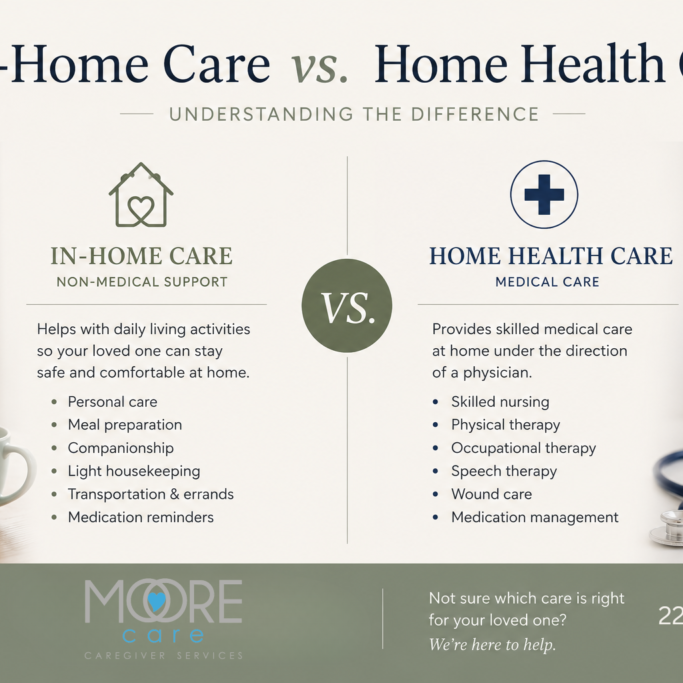
In Home Care vs. Home Health Care
When a loved one begins to need extra support, one of the first questions families ask is, “Do we need home care or home health care?” While these terms are often used interchangeably, they provide very different services. Understanding the difference can help you make the best decision for your loved one’s health, safety, and…